Sabtu, 29 Agustus 2009

inuyasha


InuYasha (犬夜叉?), full title InuYasha, a Feudal Fairy Tale (戦国御伽草子 犬夜叉, Sengoku Otogizōshi InuYasha?, lit. "Warring-States Fairy-Tale Book: InuYasha") (romanized as INUYASHA), is a Japanese manga series written and illustrated by Rumiko Takahashi. It premiered in Weekly Shōnen Sunday on November 13, 1996 and concluded on June 18, 2008. The series follows a time-traveling high school student, a half-demon, a lecherous monk, a fox demon, a demon slayer, and a nekomata during the Sengoku period as they seek to find all the fragments of the Jewel of Four Souls and to keep them out of the hands of evildoers, especially Naraku.

The manga was adapted into a 167 episode anime series produced by Sunrise. Masashi Ikeda directed the first forty-four episodes, while Yasunao Aoki directed the remainder of the series. InuYasha premiered on Yomiuri TV in Japan on October 16, 2000 and ran until September 13, 2004. The television run of the anime ceased without a conclusion to the story. In 2009, the producers announced that a second anime series was in production to animate the ending of the manga series. In 2002, the manga won the Shogakukan Manga Award for best shōnen title of the year.[1] InuYasha was ranked twenty by TV Asahi of the 100 best anime series in 2006 (based on an online survey in the country.)


Written by Rumiko Takahashi, InuYasha premiered in Japan in Shōnen Sunday on November 13, 1996 and concluded June 18, 2008. The chapters are also being published by Shogakukan in 56 collected volumes, with the first volume released in May 1997, and the last released in February 2009.

Viz Media licensed the series for an English translated release in North America. The first volume was released in March 1998. At the time, manga was normally published "flipped"--that is, printed in exact reverse order-- to conform to the American convention of reading books from left to right. This resulted in the individual pages being mirrored from the original, so the images seen are also mirrored leaving right-handed characters appearing to be left-handed. Though Viz has since stopped flipping their manga releases, as InuYasha was already well into printing by the time this change was made, it continues to be released in the flipped format. New volumes of the series are released monthly, and as of July 14, 2009, 38 volumes have been released in North America.

Viz Media is also releasing a separate series of "manga" volumes, called "ani-manga", which are derived from the anime episodes using colored frames from colored frames. These volumes are slightly smaller than the regular manga volumes, are oriented in the Japanese tradition of right to left, feature new covers with higher quality pages, and a higher price point versus the regular volumes. Each ani-manga volume is arranged into chapters that correspond to the anime episodes rather than the manga.
...READ MORE...

pokemon


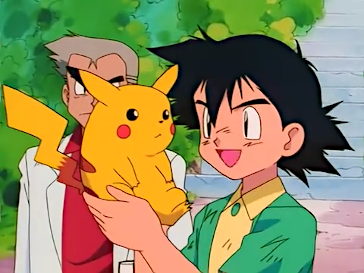
Pokémon (ポケモン, Pokemon?, English pronunciation: /ˈpoʊkeɪmɒn/[1]) is a media franchise published by the video game company Nintendo and created by Satoshi Tajiri in 1996. Originally released as a pair of interlinkable Game Boy role-playing video games, Pokémon has since become the second most successful and lucrative video game-based media franchise in the world, behind only Nintendo's own Mario series.[2] Pokémon properties have since been merchandised into anime, manga, trading cards, toys, books, and other media. The franchise celebrated its tenth anniversary in 2006,[3] and as of 23 April 2008 (2008 -04-23)[update], cumulative sales of the video games (including home console versions, such as the "Pikachu" Nintendo 64) have reached more than 186 million copies.[4]

The name Pokémon is the romanized contraction of the Japanese brand Pocket Monsters (ポケットモンスター, Poketto Monsutā?),[5] as such contractions are very common in Japan. The term "Pokémon", in addition to referring to the Pokémon franchise itself, also collectively refers to the 493 fictional species that have made appearances in Pokémon media as of the recent release of the newest Pokémon role-playing game (RPG) for the Nintendo DS, Pokémon Platinum. Like the words deer and sheep, the word "Pokémon" is identical in both the singular and plural, as is each individual species name; in short, it is grammatically correct to say both "one Pokémon" and "many Pokémon". In November 2005, 4Kids Entertainment, which had managed the non-game related licensing of Pokémon, announced that it had agreed not to renew the Pokémon representation agreement. Pokémon USA Inc. (now The Pokémon Company International), a subsidiary of Japan's Pokémon Co., now oversees all Pokémon licensing outside of Asia
...READ MORE...

ben 10


Ben 10 is an American animated television series created by "Man of Action" (a group consisting of Duncan Rouleau, Joe Casey, Joe Kelly, and Steven T. Seagle), and produced by Cartoon Network Studios. The pilot episode aired on December 27, 2005, as part of a sneak peek of Cartoon Network's Saturday morning lineup. The second episode was shown as a special on Cartoon Network's Fridays on January 13, 2006. The final regular episode aired on April 15, 2008. The theme song for the show was written by Andy Sturmer and sung by Moxy.[1] In April 2008, Ben 10 was succeeded by Ben 10: Alien Force. Currently, the latest installment of the Ben 10 series will be titled, Ben 10: Evolutions.


The Omnitrix is the mysterious watch-like alien device that allows the user to transform into various alien forms by combining the DNA of the selected alien with the user's own DNA, effectively turning them into the alien species the user has selected. The alien form is selected by unlocking the control dial, turning the control dial to the desired alien species which is displayed on the Omnitrix's display, then pressing the control dial back into place completing the transformation. The alien DNA also seems to contain some aspects of the original aliens' personality; when questioned how it felt to be an alien, Ben described it as follows: "It kinda freaked me out at first. It was like I was me... and like I was somebody else." [2]

The Omnitrix was originally created by Azmuth (a Galvan like Greymatter) to allow the people of the universe a way to literally "walk in someone else's shoes". However, many beings saw the Omnitrix's abilities as something that could be used as a powerful weapon—most prominently the villain Vilgax who claims it to be the most powerful weapon in the galaxy. Fearing that people might misuse the Omnitrix for this very reason, Azmuth put several safeguards in place to ensure that whoever used the Omnitrix would not have full access to its powers. Several of these safeguards include transforming into an alien different from the one that is selected on the control dial, the ten minute auto time-out, and the restriction of only ten accessible aliens. Even the Omnitrix's self destruct was a safeguard set in place by Azmuth. However, these safeguards are disabled once the Master Control for the Omnitrix is unlocked, which is apparently done by a random combination of selections on the control dial. Once the Master Control is unlocked, the user can stay in their alien form indefinitely and is also able to switch between alien forms at will just by thinking about it, speaking the name its user has given any alien, or turning the badge with the Omnitrix insignia on it.

In addition to the aliens that were pre-programmed into the Omnitrix's DNA sequencer by Azmuth, the Omnitrix also possess the ability to absorb DNA samples from other alien species by simply coming into contact with them, effectively downloading a DNA sample and allowing access to that form.

In the episode "Don't Drink the Water", Ben gets splashed by a pool of water from the Fountain of Youth, which transforms him to being back to age 4 again. This, unfortunately, also affects his aliens, making Fourarms 5 feet tall, Stinkfly becoming Stinkyfly, and Heatblast having a 'meltdown'. This proves, along with Ben 10,000, that the age of the Omnitrix wearer affects the alien they transform into.

To date, only Ben has unlocked the Master Control only once by complete accident. This occurred during the Season 2 finale episode while messing around with the control dial, though to make sure Vilgax wouldn't have access to the Master Control, Ben zeroed out the Master Control, putting back into place all of Azmuth's safeguards.

In the episodes "Ben 10,000" and "Ken 10", Ben's alternate future self has managed to not only unlock the Master Control, but has access to only 10,000 aliens, instead of the 1,000,903 stored in it (which is every sentient life-form in the galaxy). Also, his Omnitrix's look has been altered somewhat, though it appears to still function the same. It also appears to have grown and transformed until it reached the top of his forearm. His alien forms also appear to have changed as Ben got older.

Prior to the episode "Ken 10", Ben managed to create another Omnitrix using his aliens Grey Matter, Brainstorm and Benvicktor. He gave this to his son Ken for his birthday during the said episode. However, Ben installed a limiter into his son's Omnitrix which prevented Ken from accessing the other alien forms. In the end of the episode he ultimately deactivates the limiter and unlocks the Master Control.

At some point in the years between the original series and Ben 10: Alien Force, Ben managed to remove the Omnitrix by an unknown but difficult process. When Ben puts it back on, the Omnitrix reconfigures into a more watch-like shape, and recalibrates itself along with the aliens available, giving Ben access to a new set of more powerful alien forms and a holographic alien display, rather than merely presenting the silhouettes of the aliens. Also, Ben has lost his previous alien transformations, although it keeps the powers and adds new ones; this is noted in "Ben 10 Returns", when he first uses the new Omnitrix and states that he doesn't recognize anyone in his selection, in "Everybody Talks About the Weather", when he told Alan Albright that he used to turn into Heatblast, and in "Pier Pressure" when he saw a Galvanic Mechomorph and told Julie that he used to be able to turn into Upgrade. Ben himself also retains any injuries suffered by his alien forms, although this has not been shown to be any real problem as of yet. After the recalibration, the Omnitrix seems to grant Ben more stable control over its powers as seen in the first and the following episodes where Ben successfully transforms to his desired alien, switch between alien forms, and revert to his human form by will without the intervention of the ten minute auto time-out; though eventually its power will deplete and Ben will revert to his original state and cannot transform until the watch has fully recharged. In addition to the new functions that have been said, the new Omnitrix has the ability to repair genetic damage, such as that caused by DNAlien mutation. It uses a previously unseen speech function to inform Ben of this feature. The Omnitrix also has the same voice as Ben. Also, it appears that the new Omnitrix deactivated the pulse that is send off when someone tries to remove the Omnitrix from the host. In the original series, it was triggered twice: once by Kevin trying to remove it when he had absorbed energy from Fourarms, and again by Kevin and Vilgax when they used a device to remove it. However, when Ben's parents find out about the Omnitrix, his father tries to remove it, but the pulse doesn't activate. Kevin mentioned in one episode that the Omnitrix is equipped with a translation program, which explains why Ben was able to communicate and converse with the different alien species he has encountered so far.

In the Ben 10: Alien Force episode "War of the Worlds", it is revealed that the Omnitrix contains the DNA of every sentient species in the galaxy, totaling 1,000,903. Azmuth likens it to Noah's Ark, in that it could restore any of those 1,000,903 species, should they ever become extinct. In the episode Good Copy, Bad Copy, Azmuth explained the consequences that if a second Omnitrix is created, and if it comes into close proximity with the other one, it will result in a cataclysmic explosion that would destroy the entire universe.
...READ MORE...

gundam


Gundam (ガンダム, Gandamu?) is a metaseries of Japanese anime created by Sunrise studios that features giant robots (or "mecha") called "Gundam." The metaseries started in 7 April 1979 as a serial TV show called Mobile Suit Gundam. That first TV series has since spawned a franchise that has come to include works released in numerous media. Titles have appeared in the form of multiple television series and OVAs, movies, manga, novels and video games, among other modes. The story from the original 1979 series has been considerably extended with sequels, prequels, side stories and alternate timelines. As a result, the title "Gundam" has become a collective term for the seven distinct but related timelines that can be pieced together from the stories that appear in the Gundam franchise. Generally speaking, the timelines do not intersect, but they do contain a few common elements such as the titular war machines called Gundam. However, all Gundam timelines/worlds long after their own anime series will eventually intersect and combine back to one in the series Turn A Gundam. [1][2]

The original timeline for the Gundam series was the Universal Century (UC) series, which included Mobile Suit Gundam (1979) and Mobile Suit Zeta Gundam (1985). Since the 1990s, alternative timelines have been produced and developed, including the Future Century, After Colony, After War, Correct Century, Cosmic Era and Anno Domini timelines.

As of January 21, 2008, the Gundam franchise is a 50 billion yen trademark.[3] In the 2008 ranking of average sales figures for anime copies sold in Japan (1970-2008 total sales figures averaged by episode), Gundam series were in 4 of the top 5 places: Mobile Suit Gundam ranked second, with Mobile Suit Gundam SEED Destiny third, Mobile Suit Gundam SEED fourth, and Mobile Suit Zeta Gundam fifth. Also, New Mobile Report Gundam Wing ranked 18th and Mobile Suit Gundam ZZ ranked 20th.[4] Gunpla's (Gundam Plastic model) income is 90% of the Japan character plastic model market's income.[5]

Academic fields in Japan have also viewed the series as a good inspiration in research fields, with the Gundam academy (or officially International Gundam Society) being the first academic institution based on an animated TV series
...READ MORE...

yu-gi-oh!


Yu-Gi-Oh! (遊☆戯☆王, Yū☆gi☆ō?, lit. "Game King") is a Japanese manga created by Kazuki Takahashi. It has spawned a franchise that includes multiple anime shows, a trading card game and numerous video games. Most of the incarnations of the franchise involve the fictional trading card game called Duel Monsters (originally known as Magic & Wizards), where each player uses cards to "duel" each other in a mock battle of fantasy "monsters". The Yu-Gi-Oh! Trading Card Game is the real world counterpart to this fictional game on which it is loosely based.


Yu-Gi-Oh! tells the tale of Yugi Mutou, a shorter-than-average high school student who was given the fragmented pieces of an ancient Egyptian artifact, the Millennium Puzzle, by his grandfather. Upon reassembling the Puzzle, he is possessed by another personality who is later revealed to be the spirit of a 3,000-year-old Pharaoh (5,000-years-old in the English anime) called Atem, with no memory of his own time. As the story goes on, the two of them (together with Yugi's friends), try to find the secret of the Pharaoh's lost memories and his name, with the Duel Monsters card game being an ever prevalent backdrop or plot device.

Yu-Gi-Oh! GX is set 10 years after the first series. It follows the story of Jaden Yuki (Judai Yuki in the Japanese version), a young talented duelist who is given the card "Winged Kuriboh" by Yugi before Jaden's admission to Duel Academy (Duel Academia in the Japanese version), an elitist boarding school established by Seto Kaiba. Jaden (who receives low marks in his admission tests), is placed in the Slifer Red dormitory (Osiris Red), which is reserved for students with the lowest grades. The story goes on as Jaden faces challenges from different students in Duel Academy. He later finds himself entangled in a conflict related to the hidden secrets of the academy.

Yu-Gi-Oh! 5Ds is set in a distant future where the residents of the poverty-stricken town called Satellite provide the manpower to sustain a utopia called New Domino City (Neo Domino City in the Japanese version), a futuristic version of the city of Domino where some of the events of the original Yu-Gi-Oh! took place. The story centers around five characters known as Signers, who have birthmarks bearing one part of a monster called the Crimson Dragon (which saved the world in the past,from the Earthbound Immortals). The main character, named Yusei Fudo, is a Signer. Each Signer has a dragon monster. In later episodes, they fight Dark Signers—duelists who try to revive the Earthbound cards.

The early chapters of Yu-Gi-Oh! feature a variety of different games; but from the Duelist Kingdom arc onwards, the focus is shifted to a card game called Duel Monsters. Duel Monsters is played using a holographic image system created by Seto Kaiba (following his first Shadow Game with Yugi). In the manga and first series anime, these were initially performed on tables, using holographic tubes, while the second series anime uses huge holographic fields. Starting with the Battle City arc, (as well as the series that followed), duels are performed using portable Duel Disks, invented by Seto Kaiba, which allows duels to happen anywhere.
...READ MORE...

death note


Death Note (デスノート, Desu Nōto?) is a Japanese manga series created by writer Tsugumi Ohba and manga artist Takeshi Obata. The series centers on Light Yagami, a university student who discovers a supernatural notebook, the "Death Note", dropped on Earth by a shinigami (death god) named Ryuk. The Death Note grants its user the ability to kill anyone whose face they have seen, by writing the victim's name in the notebook. The story follows Light's attempt to create and rule a world cleansed of evil using the notebook, and the complex conflict between him, his opponents and a mysterious detective known to the world only as L.

Death Note was first serialized in 108 chapters by Shueisha in the Japanese manga magazine Weekly Shōnen Jump from December 2003 to May 2006. The series was also published in tankōbon format in Japan starting in May 2004 and ending in October 2006 with a total of twelve volumes. The series was adapted into live-action films released in Japan on June 17, 2006, on November 3, 2006, and on February 2, 2008. The anime series aired in Japan from October 3, 2006, to June 26, 2007. Composed of 37 episodes, the anime was developed by Madhouse and directed by Tetsuro Araki. A light novel based on the series, written by Nisio Isin, was released in Japan. Additionally, various video games have been published by Konami for Nintendo DS.

Viz Media licensed the Death Note manga in North America and has published all the twelve volumes from the series as well as the light novel. The episodes from the anime first appeared in North America as downloadable by IGN. Viz later licensed the anime series and it aired on Bionix. The live-actions briefly played in certain North American theaters since 2008. However, none of the video games titles have thus far been published in North America.

Several publications for manga, anime and other media have added praise and criticism on the Death Note series. The plot and violence from the story have been praised, noting it to be very entertaining. However, the series was banned in China due to various problems people had with children altering their notebooks to resemble the Death Note.
...READ MORE...

yuyu hakusho


YuYu Hakusho (幽☆遊☆白書, Yū Yū Hakusho?, or "YYH", lit. "Ghost Files" or "Poltergeist Report"[1]), also known as Ghost Fighter,[2] is a Japanese manga series written and illustrated by Yoshihiro Togashi with an anime adaptation. The name of the series is spelled Yu Yu Hakusho in Funimation's distribution of the anime and YuYu Hakusho in the Viz manga.

The manga was originally published in Shueisha's Weekly Shōnen Jump. The series consists of 175 chapters collected in 19 tankōbon volumes, and won the Shogakukan Manga Award for shōnen in 1994.[3] In North America, the manga currently runs in Viz's Shonen Jump.

The anime, directed by Noriyuki Abe and co-produced by Fuji Television, Yomiko Advertising, and Studio Pierrot, consists of 112 television episodes and two movies: The Golden Seal and Bonds of Fire. The anime series won the Animage Anime Grand Prix prize in 1993 and 1994. The TV series originally aired on Japan's Fuji Television network from October 10, 1992 to January 7, 1995, and was later licensed in North America by Funimation in 2001. The show first aired on US TV on February 2002 on Cartoon Network's Adult Swim block. Around March 2003, the show moved to Cartoon Network's Toonami block due to higher ratings. YuYu Hakusho was taken off Toonami around March 2005 and moved to an early Saturday morning time slot at 5:30 a.m. Eastern time where the series finished its run. It also aired as part of the Funimation programming block on Colours TV.

A series of YuYu Hakusho OVAs were released only in Japan. The television series has also been broadcast across Japan, East Asia, Southeast Asia, and the Indian subcontinent by the anime satellite television network Animax.
...READ MORE...

free game download © 2008 Template by:
SkinCorner